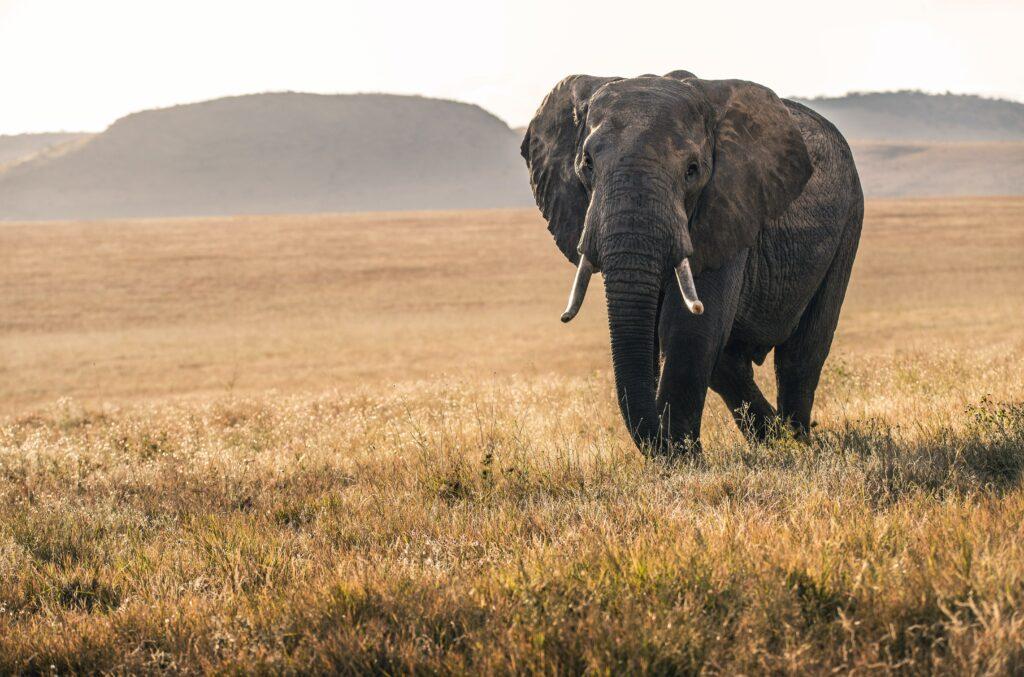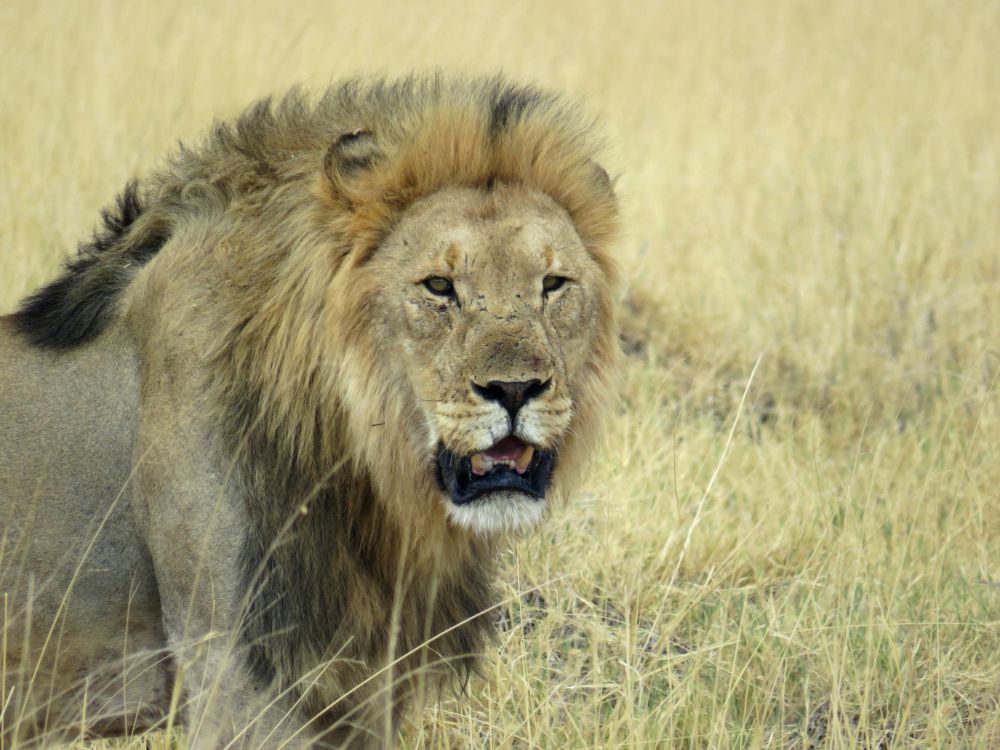
Trophy Elephant Hunting in Namibia – Bushmanland
Booking Season: 2026
Hunt Difficulty: Difficult

Namibia may not be the right choice for hunters seeking dense game populations, short stalking distances, or high daily shot opportunities. Its appeal lies in space, patience, and deliberate hunting rather than fast-paced volume shooting.
Step into one of Africa's most respected hunting destinations — a country where vast, untouched landscapes reward patience, skill, and deliberate hunting. From classic plains game safaris to the pursuit of big game, Namibia offers a remarkable combination of species variety, well-managed wildlife populations, and reliable safari infrastructure. Hunters can explore diverse terrain across the country's major regions, each presenting its own unique challenges and hunting style. For those seeking iconic African trophies, Namibia's hunting opportunities extend to species like kudu, gemsbok, elephant, and buffalo. Plan your hunting safari in Namibia, where the adventure unfolds across open savannahs, mountain ranges, and ancient desert landscapes.
More About Game Hunting in Namibia
Namibia On Map
You Might Also Like
Hunts Currently Available
Trophy Elephant Hunting in Namibia – Bushmanland
Booking Season: 2026
Hunt Difficulty: Difficult

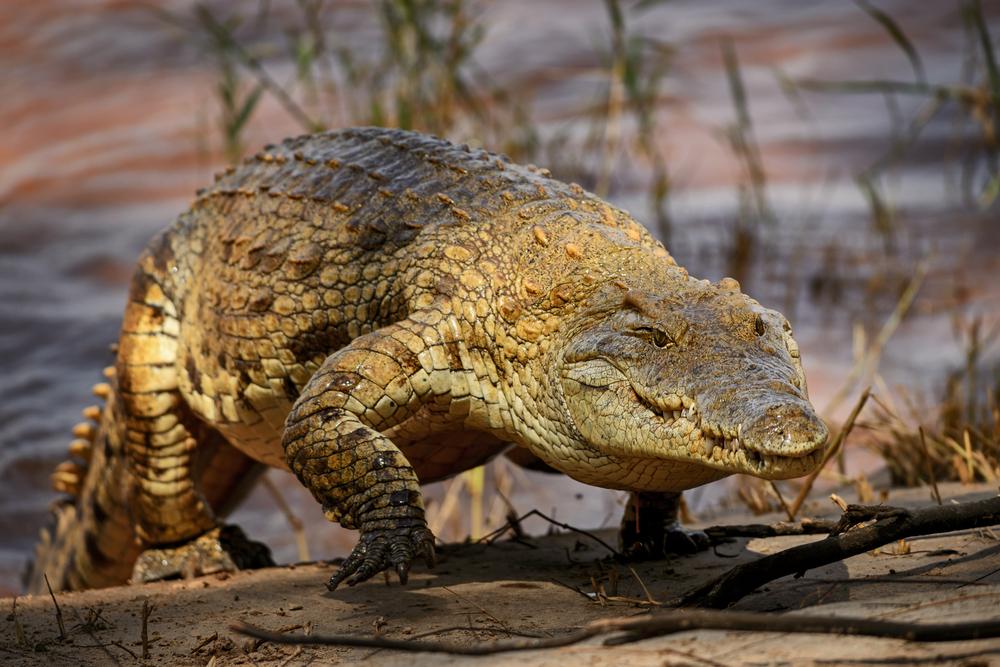
Giant Crocodile Hunt in the Caprivi Namibia Non-Exportable
Booking Season: 2026
Hunt Difficulty: Moderate, Difficult
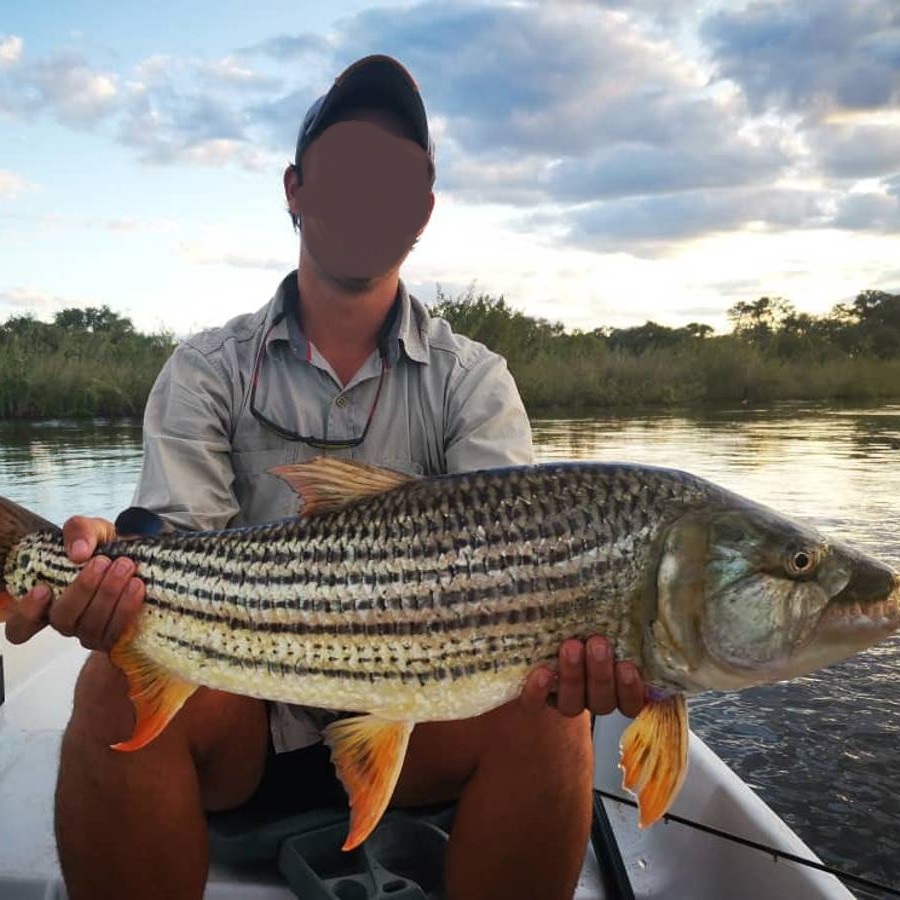
8-Day Fishing & Hunting Adventure in Namibia
Booking Season: 2026
Hunt Difficulty: Moderate
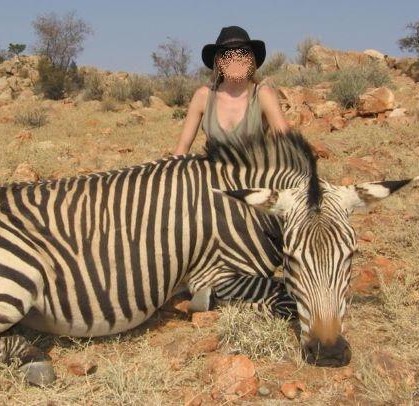
African Plains Game Hunt x 5 days x 4 species in Namibia
Booking Season: 2026
Hunt Difficulty: Moderate
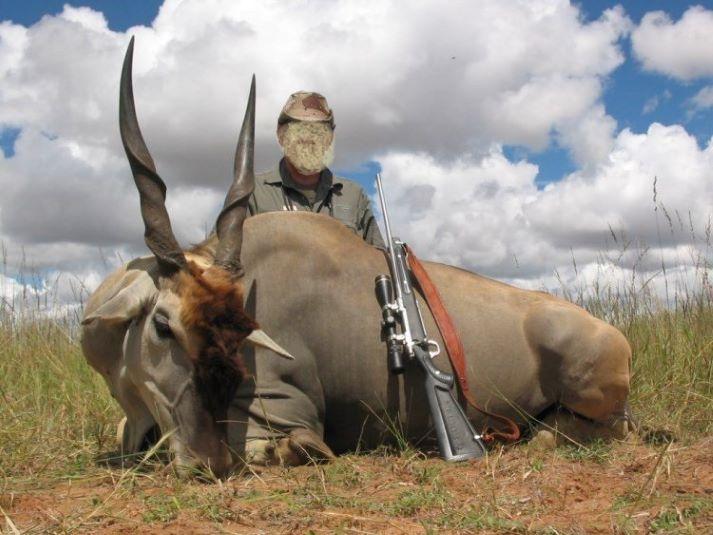
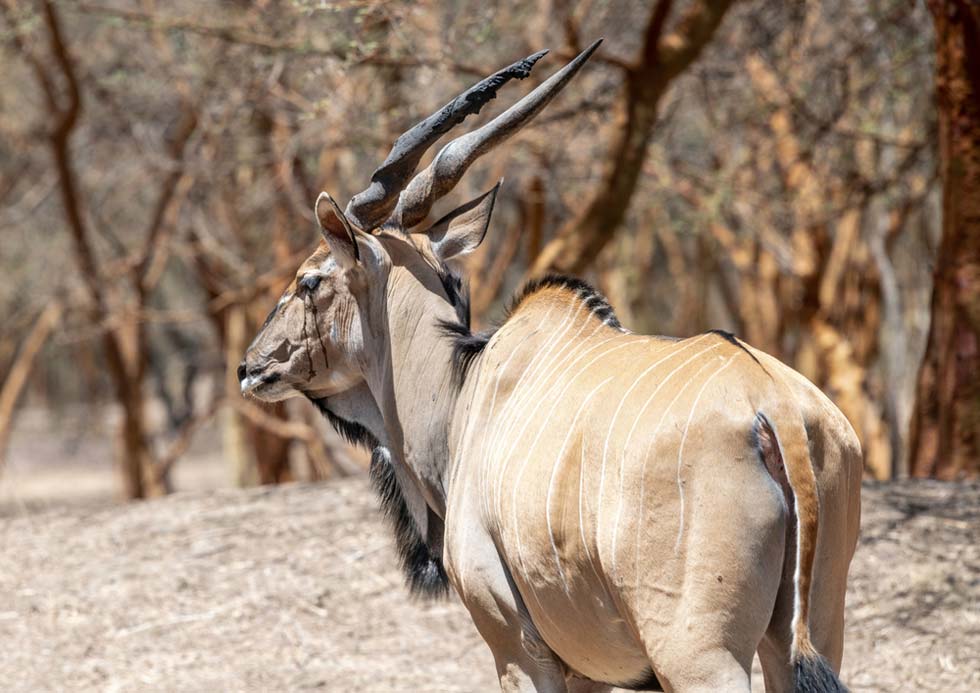
Hunting in Namibia Kudu, Cape Eland and 4 Species
Booking Season: 2026
Hunt Difficulty: Moderate

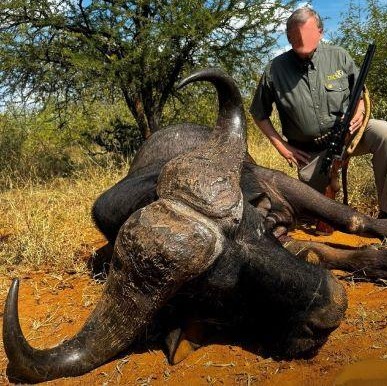
Non-Exportable Cape Buffalo Hunt Caprivi Strip, Namibia
Booking Season: 2026
Hunt Difficulty: Difficult
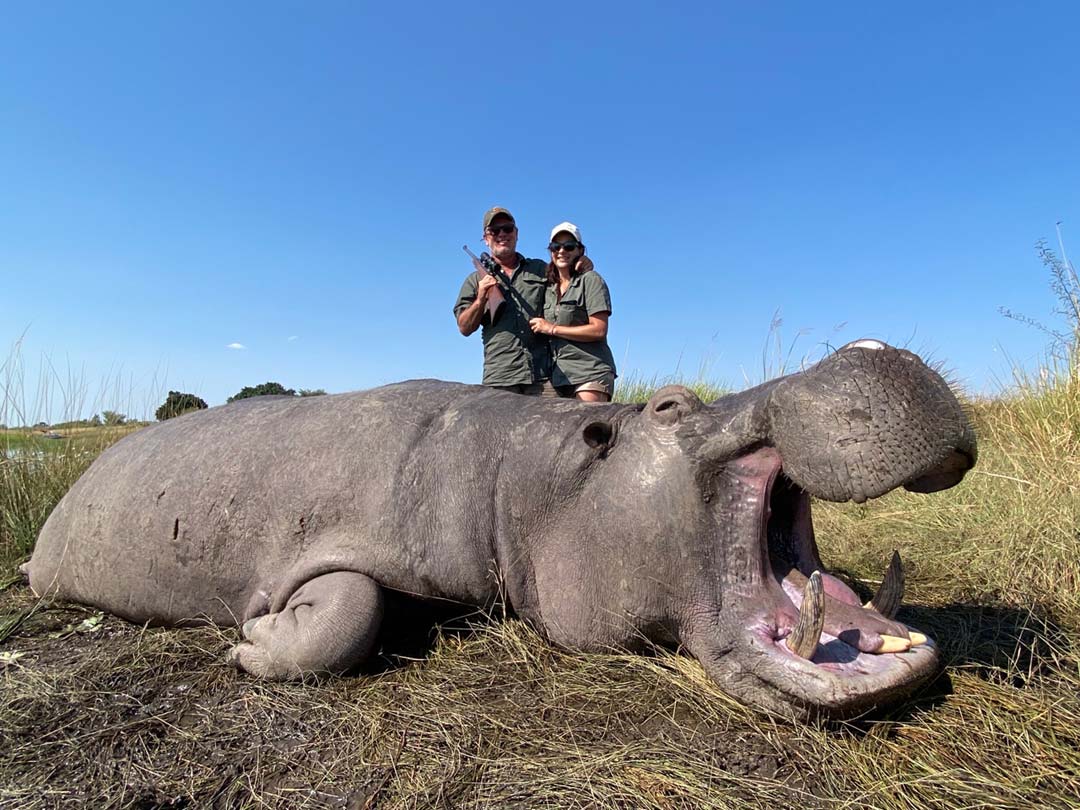
Hippo Hunting Safari in Namibia Non-Exportable
Booking Season: 2026
Hunt Difficulty: Difficult
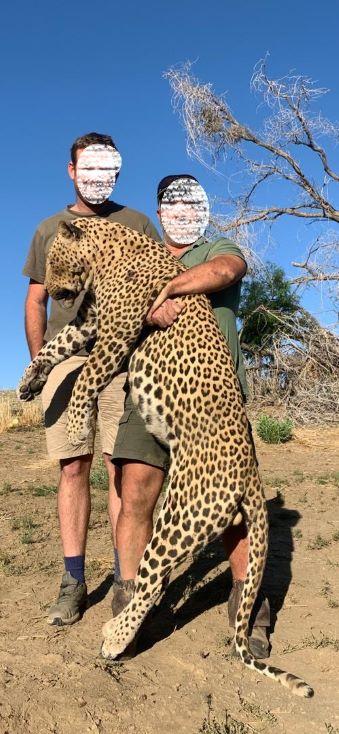
Leopard Hunting in Namibia plus 2 x Tiny Ten 14 Days
Booking Season: 2026
Hunt Difficulty: Moderate, Difficult
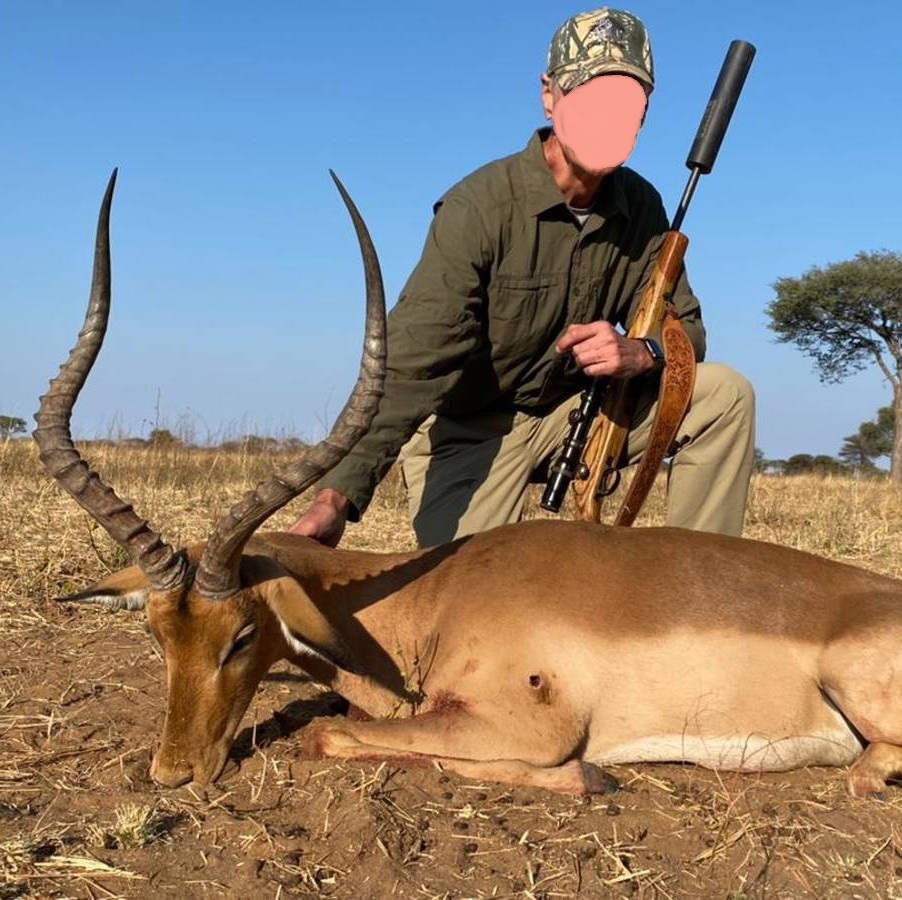
Hunt Zebra, Impala, Blue Wildebeest & Gemsbok in Namibia
Booking Season: 2026
Hunt Difficulty: Moderate
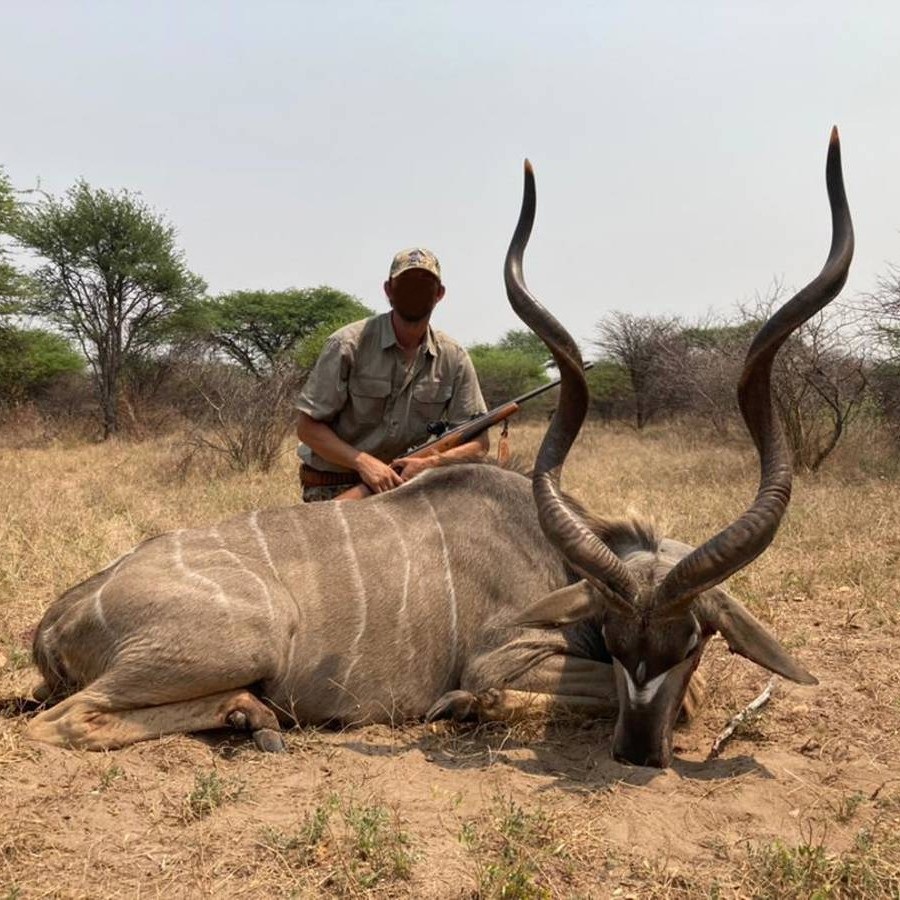
African Plains Game Extravaganza in Namibia: 9 Species in 12 Days!
Booking Season: 2026
Hunt Difficulty: Moderate
Embark on an extraordinary journey into Africa's finest plains game hunting destination with Game Hunting Safaris in Namibia — where patience, skill, and open landscapes define every safari.
Namibia stands apart from other African hunting destinations through its combination of species variety, long-term wildlife management, and a style of hunting that rewards genuine skill. The country is vast, dry, and sparsely populated — mountains, thornveld, red sand dunes, and open savannah stretch for miles across the landscape. Animals here use terrain well and rarely reveal themselves easily, which is exactly why experienced hunters return again and again. Tailored Namibia hunting packages connect visiting hunters with experienced professional hunters and well-appointed hunting lodges, ensuring comfort and quality throughout the safari. Hunters can pursue an outstanding range of plains game species — including the iconic kudu, gemsbok, springbok, and eland — while select regions in the north and northeast offer access to dangerous game including elephant, buffalo, and hippopotamus. Discover the untamed scale of Namibia with us.
Namibia has become one of Africa's most respected hunting safari destinations for international hunters. For many international hunters, the country offers a combination that is surprisingly difficult to find elsewhere: a wide variety of huntable species, well-managed wildlife populations, reliable travel logistics, and safari pricing that often allows hunters to pursue several animals during a single trip.
But Namibia is not a place where hunting happens quickly.
Many hunters arrive expecting easy hunting and quickly discover something different — a country that rewards patience, careful glassing, and thoughtful stalking. The country is vast, dry, and sparsely populated. Mountains, thornveld, red sand dunes, and open savannah stretch for miles across the landscape. Animals use this terrain well, and they rarely reveal themselves easily.
Many mornings begin behind a pair of binoculars at first light, glassing distant hillsides or scanning the edges of thornveld for movement. When an animal is finally spotted, the real work begins — checking the wind, studying the terrain, and planning a careful approach to close the distance without being detected. The hunt often starts long before the shot.
For hunters who appreciate the process of hunting — the glassing, the tracking, and the challenge of getting within range of an animal that didn't grow old by accident — Namibia can be an incredibly rewarding place to hunt.
One of the reasons Namibia has earned such a strong reputation among international hunters is its wildlife management system. Over the past several decades, Namibia has developed a conservation model where wildlife carries real economic value. Private landowners and communal conservancies manage wildlife populations under government regulation, and hunting revenue helps support both habitat protection and rural employment.
The results have been significant. Wildlife numbers in many regions have increased steadily. Large areas that once supported only livestock now hold thriving populations of plains game, while certain regions in the north and northeast still support dangerous game species.
For visiting hunters, this system creates an important balance. Wildlife is not simply protected — it is actively managed, valued, and sustained across large landscapes. Landowners, communities, and professional hunters all play a role in ensuring wildlife continues to thrive.
Namibia is sometimes misunderstood by hunters planning their first African safari. This is not a destination built around extremely dense game populations where animals are encountered every few minutes. Nor is it primarily known for massive government concession blocks like those found in parts of East Africa.
Instead, Namibia is known for a different style of hunting. It is one of the most reliable countries in Africa for classic plains game safaris, particularly for species such as kudu, gemsbok, springbok, and eland.
Animals here learn to survive in open landscapes where visibility can stretch for miles. They use terrain, wind, and vegetation to their advantage, often disappearing into broken ground or thornveld long before a hunter closes the distance. Successful hunts often begin with glassing distant animals, studying their movement, and planning a stalk that may take considerable time before a shooting opportunity appears.
That deliberate, patient style of hunting is exactly why many experienced hunters return to Namibia again and again.
Namibia attracts hunters from around the world for several practical reasons.
First, the country offers tremendous species variety. A well-planned safari can include several plains game animals, and in some regions dangerous game may also be available.
Second, Namibia remains one of the more accessible African destinations for visiting hunters. International flights arrive in Windhoek, and many hunting areas can be reached by vehicle within a few hours. Importing a hunting rifle is generally straightforward when paperwork is prepared in advance. Temporary firearm permits are issued upon arrival, and professional outfitters are accustomed to guiding visiting hunters through the process. For hunters traveling internationally with their own rifles, this simplicity removes much of the uncertainty often associated with planning an African safari.
Pricing also plays a role. Compared with some African destinations, Namibia often allows hunters to pursue multiple animals within a single safari budget. For many visiting hunters, this makes a well-rounded African hunting experience far more achievable.
Perhaps the most striking characteristic of Namibia is the sense of scale. It is one of the least densely populated countries in the world. Mountains, desert plains, and open savannah stretch across vast distances with very little human development.
For hunters, this means animals behave naturally and move across large areas of habitat. A typical day may begin with glassing distant hillsides at first light, tracking animals across sandy soil, or slowly working through thornveld while constantly paying attention to wind direction. When an opportunity develops, the stalk itself becomes the real challenge — closing the distance carefully while staying hidden from animals that have learned to survive in wide open country.
Success in Namibia rarely comes from rushing. It comes from patience, careful observation, and the willingness to spend time studying the landscape and the animals that live within it. That style of hunting is not for everyone. But for hunters who enjoy the challenge, Namibia offers one of the most authentic safari experiences available anywhere in Africa.
Namibia tends to appeal to a very specific type of hunter. Many visitors arrive expecting a fast-paced hunt with animals appearing constantly throughout the day. While wildlife numbers are healthy across much of the country, Namibia rewards a different approach — patience, observation, and careful stalking across large landscapes.
Hunters who tend to enjoy Namibia the most are those who appreciate the full process of hunting. These are often hunters who enjoy spending time behind binoculars, studying distant hillsides or sand dunes while trying to pick out the outline of an animal that blends almost perfectly into the terrain. When an opportunity finally develops, the stalk itself often becomes the most memorable part of the experience.
Namibia is also particularly well suited to hunters who want to pursue several plains game species during a single safari. Because many hunting areas support a wide variety of animals, a well-planned hunt can provide opportunities for multiple species without needing to relocate camps.
For hunters interested in a traditional African plains game safari — especially those dreaming of animals like kudu, gemsbok, springbok, and eland — Namibia offers one of the most reliable and rewarding destinations on the continent.
Although Namibia offers excellent hunting opportunities, it may not be the perfect destination for every hunter. Hunters looking for extremely dense game populations where animals appear frequently throughout the day sometimes prefer destinations where wildlife concentrations are higher in smaller areas. Similarly, hunters focused primarily on dangerous game safaris often look toward countries that specialise more heavily in those experiences, such as Tanzania or Zimbabwe.
Namibia's true strength lies in its classic plains game hunting across large, open landscapes. The hunting here tends to be deliberate and methodical. Long periods of glassing or tracking are common, and successful stalks may require patience and careful planning before a shot opportunity develops. For hunters who enjoy that challenge, Namibia can be deeply rewarding. But hunters expecting constant shooting opportunities may find the pace of the hunt slower than they initially imagined.
Namibia's hunting landscape is not uniform. The country covers a vast area, and terrain changes dramatically from one region to another. These regional differences influence everything from stalking strategy to shot distance and even the type of animals hunters are most likely to encounter. Understanding Namibia's major hunting regions helps hunters choose the safari environment that best matches their expectations.
The Khomas Highlands form part of the mountainous central region of Namibia and are widely regarded as one of the country's classic plains game hunting environments. The terrain consists of rugged hills, rocky ridges, and deep valleys covered with thornveld and scattered acacia trees. Elevation changes are constant, and visibility can shift dramatically depending on the slope or ridge a hunter is standing on.
From a hunting perspective, the Khomas Highlands reward patience and careful glassing. Many mornings begin with hunters behind binoculars scanning distant hillsides and valley systems, looking for the flick of an ear or the outline of an animal standing briefly in open ground. Once an animal is located, the real work begins. Wind direction becomes critical, and successful stalks often involve circling ridges, dropping into valleys, or slowly working along rocky slopes to stay hidden. The terrain frequently allows hunters to close distance, but reaching the right shooting position can require careful movement through broken ground and thorn cover.
This region is particularly well known for producing excellent Greater Kudu, which thrive in the broken mountain habitat. Other commonly hunted species include gemsbok, red hartebeest, warthog, and plains zebra. For many hunters, pursuing a mature kudu bull through this rugged terrain represents one of the classic Namibian safari experiences.
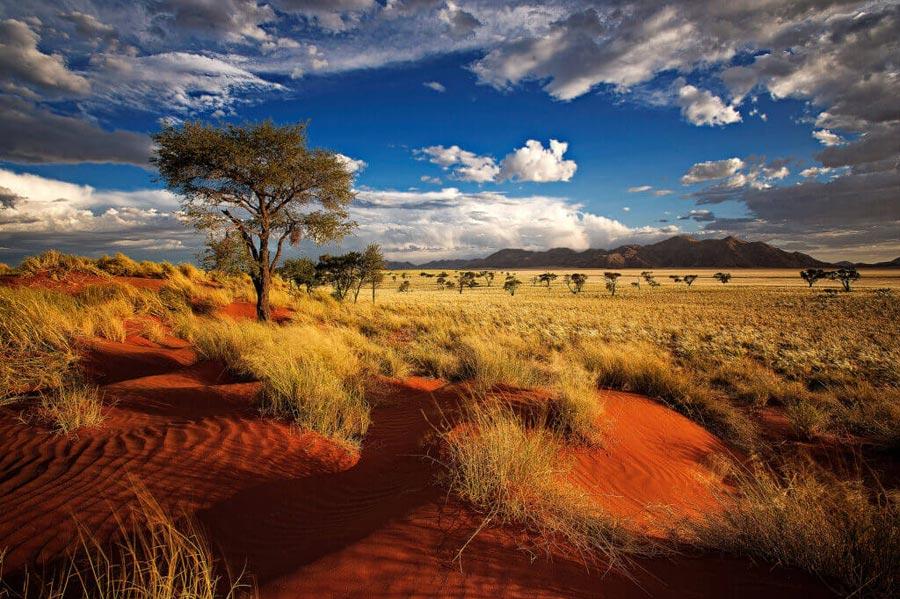
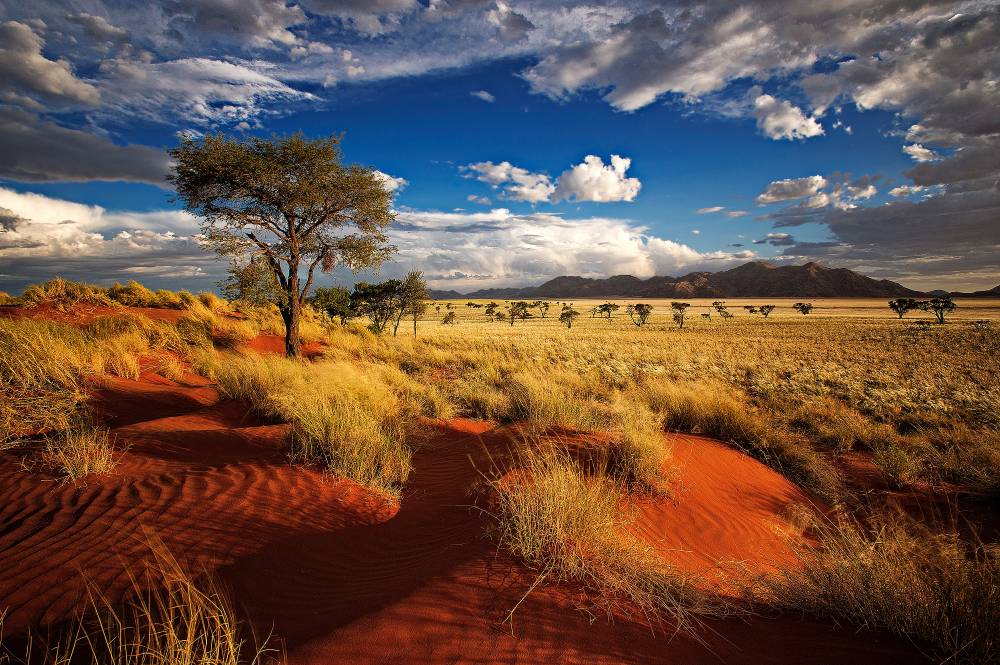
Eastern Namibia gradually transitions into the vast red sand dune systems of the Kalahari Desert. Unlike the mountainous terrain of the Khomas Highlands, the Kalahari is defined by long rolling sand ridges, scattered camelthorn trees, and wide valleys stretching between the dunes.
Although the landscape appears open at first glance, animals use the terrain remarkably well for cover. Hunting here often begins by glassing from elevated dunes or ridgelines where hunters can study the surrounding valleys. Once animals are located, the dunes themselves become valuable cover. Hunters often use the contours of the sand ridges to approach animals without being detected. The softer sand also makes tracking easier, allowing experienced trackers to follow fresh spoor and interpret animal movement patterns across the dunes. Because of the more open terrain, shot opportunities can sometimes occur at longer distances than in heavily vegetated areas. Wind across the dunes can also influence stalks, particularly during the afternoon when conditions often become more variable.
The Kalahari is especially well known for strong populations of gemsbok, springbok, eland, and kudu. The combination of open terrain, strong wildlife populations, and the iconic red sand landscape makes this one of Namibia's most visually striking hunting environments.
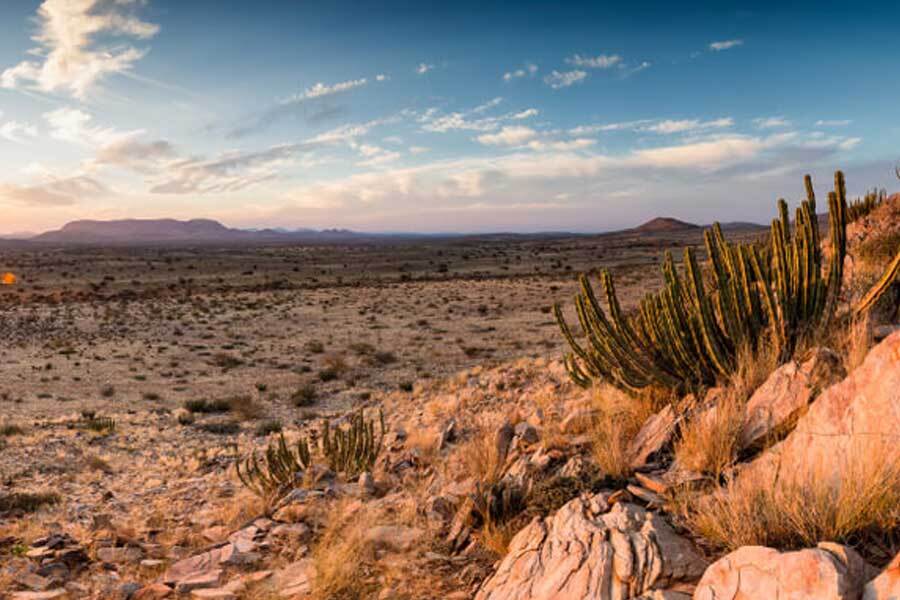
In northwestern Namibia, the landscape becomes even more rugged and arid. The region known as Damaraland is characterised by dry riverbeds, rocky hills, and desert plains that stretch toward the Skeleton Coast. Wildlife here has adapted to survive in extremely harsh conditions. Animals often travel long distances between water sources, and tracking frequently follows dry river systems where spoor remains visible in sandy ground. Hunting in this environment can involve long tracking sessions across rocky terrain and dry river valleys.
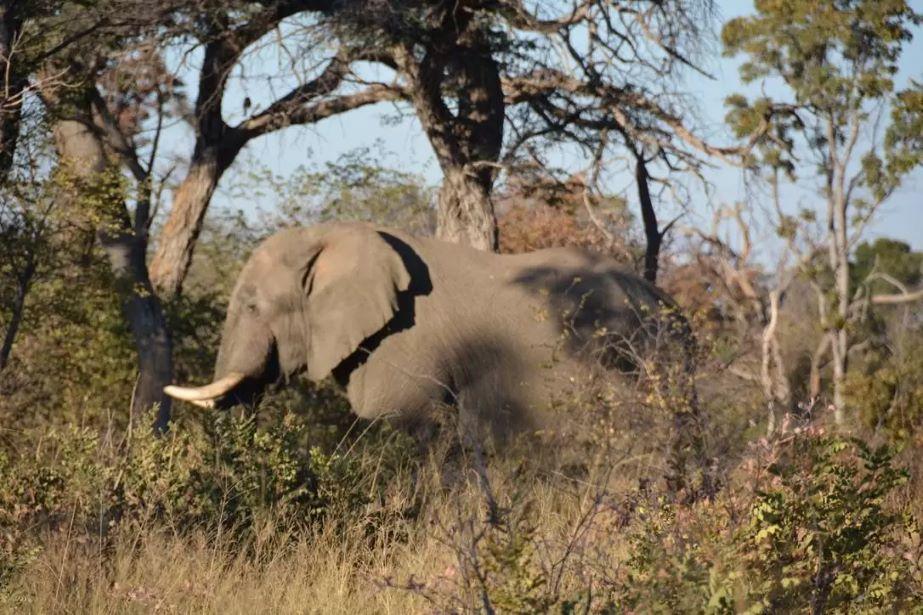
Damaraland is particularly famous for its population of desert-adapted African Elephant, which have learned to survive in one of the driest environments in Africa. However, hunting opportunities for these elephants are extremely limited and tightly regulated.
Large areas surrounding Etosha National Park provide excellent habitat for a wide range of plains game species. While hunting does not occur inside the national park itself, neighbouring private hunting areas benefit from wildlife populations that move through the surrounding ecosystems. The terrain here includes a mixture of open savannah, bushveld, and salt pan environments. Because of the natural water systems and grazing areas around Etosha, hunters may encounter a variety of plains game species during a single safari.
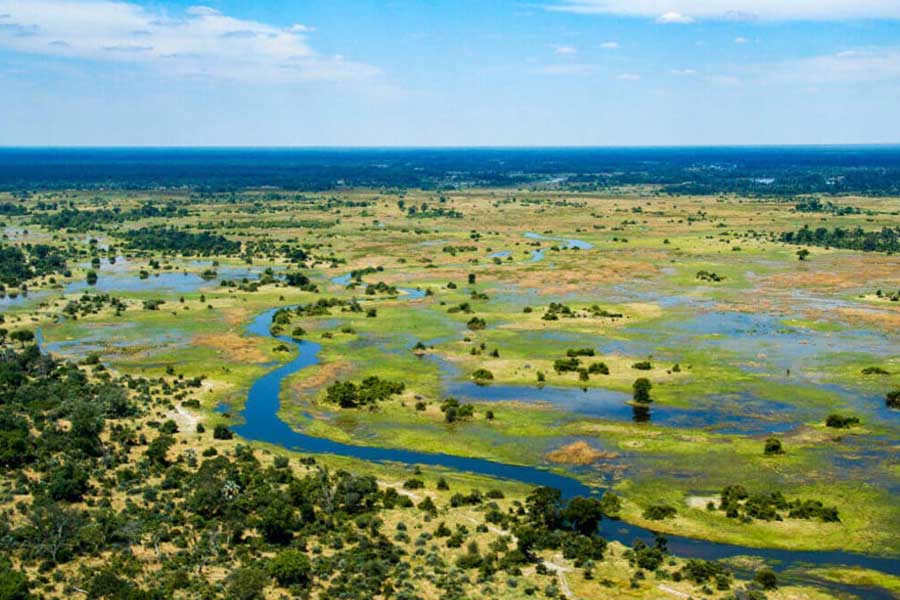
In the far northeast of the country lies the Zambezi Region, historically known as the Caprivi Strip. This region is dramatically different from the rest of Namibia. Instead of mountains or desert plains, the landscape is shaped by river systems, floodplains, and thick riverine vegetation connected to the Chobe River and the wider Zambezi basin. The terrain here is generally flat, and visibility across floodplains can extend for long distances. Because of this, shots on animals such as elephant or buffalo may sometimes occur further than hunters initially expect.
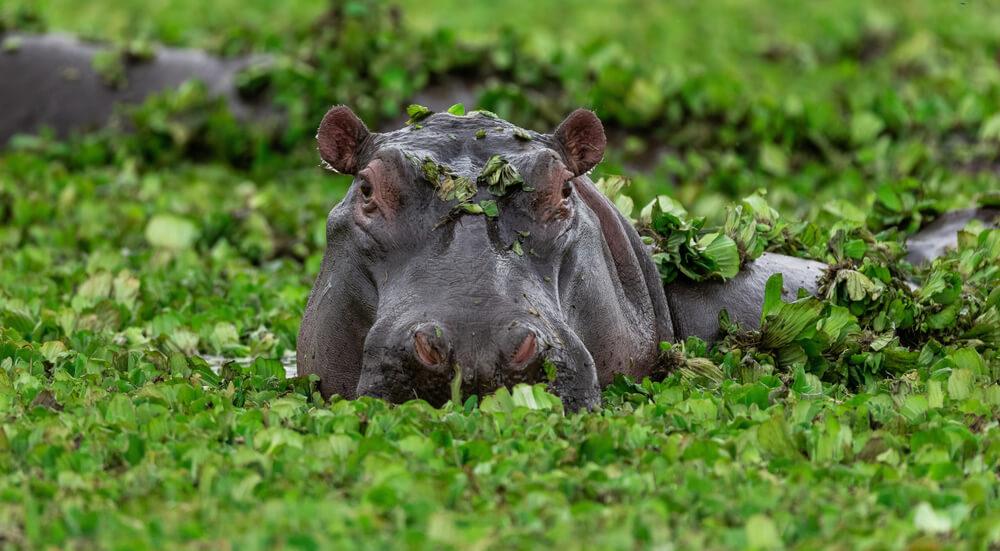
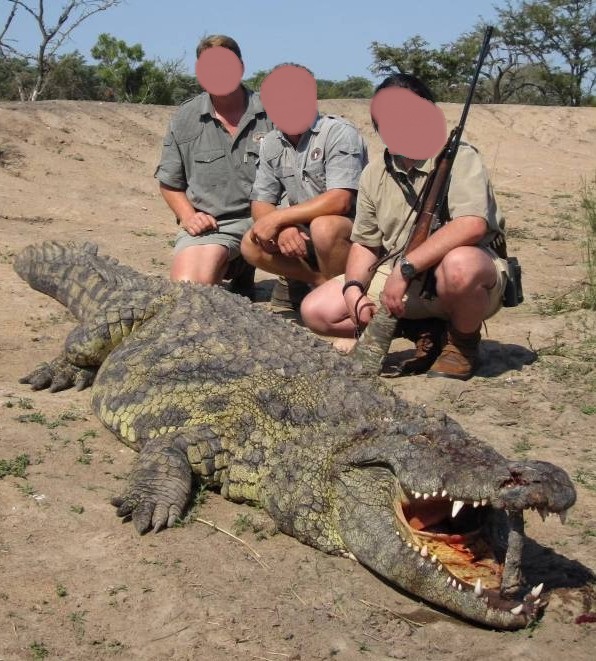
Wildlife movement in the Zambezi region is strongly influenced by seasonal flooding. During the rainy months, large areas of the floodplain fill with water, concentrating animal movement along higher ground. As the dry season progresses and water levels recede, animals begin moving more predictably between river systems and feeding areas. This region is one of Namibia's primary dangerous game areas and may offer opportunities to hunt elephant, buffalo, hippopotamus, and crocodile. Many elephants in this region move between Namibia and Botswana along the Chobe river systems, and hunts sometimes involve patiently waiting along these natural travel corridors.
Choosing the right hunting region in Namibia affects far more than scenery. It influences stalking style, average shot distance, species availability, and the physical effort required during the hunt. Some hunters prefer mountainous terrain where careful stalking is required. Others enjoy the wide open landscapes of the Kalahari or the river systems of the Zambezi region. Understanding these regional differences helps hunters plan a safari that matches both their expectations and their preferred hunting style.
One of the reasons hunters return to Namibia year after year is the variety of species that can be pursued across very different landscapes. But successful safaris rarely begin with a long checklist of animals. Experienced hunters usually approach Namibia with a clear plan: choose one or two primary species, then build additional hunting opportunities around those animals depending on terrain, season, and the time available during the safari.
Because Namibia's ecosystems vary significantly, species selection should always match the region being hunted. Animals that thrive in mountainous terrain behave very differently from those living in open sand dunes or floodplain environments. Understanding that relationship between species and habitat helps hunters plan more realistic and rewarding safaris.
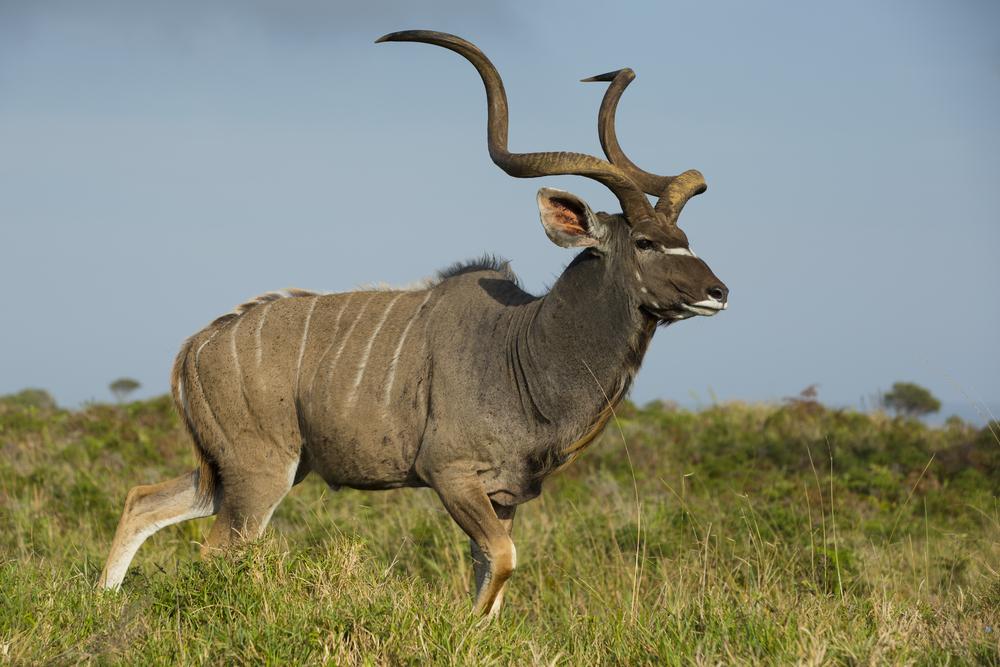
Among plains game species, few animals capture the imagination of hunters quite like the Greater Kudu. Namibia is widely regarded as one of the most reliable destinations in Africa for pursuing mature kudu bulls. The country's combination of mountainous terrain, dry bushveld habitat, and long-term wildlife management has allowed many bulls to reach older age classes.
In areas such as the Khomas Highlands and parts of the Kalahari, kudu grow impressive spiral horns while learning to use rugged terrain and thick vegetation to their advantage. This is one reason kudu are often referred to as the "grey ghost." Even large bulls can disappear into broken terrain within seconds once they catch movement or the faint swirl of human scent.
For many hunters traveling to Namibia, pursuing a mature kudu bull becomes one of the defining moments of the entire safari.
While kudu often receive the most attention, Namibia's true strength lies in the diversity of its plains game hunting. Across the country, hunters may pursue animals such as gemsbok, springbok, eland, red hartebeest, plains zebra, and warthog.
Because many hunting properties support several species across the same landscape, a well-planned safari can allow hunters to pursue multiple animals without relocating camps. However, attempting to hunt too many species in a short timeframe can sometimes reduce the overall quality of the experience. A more effective approach is to prioritise a few key animals while remaining flexible for additional opportunities that naturally arise during the hunt. Often the most memorable trophies are the animals encountered unexpectedly while pursuing another species.
Namibia is not primarily known as a dangerous game destination in the same way that countries such as Tanzania or Zimbabwe are. However, certain regions of Namibia — particularly the Zambezi Region — do support populations of dangerous game. Hunters in these areas may pursue elephant, buffalo, hippopotamus, and crocodile.
These hunts typically occur along river systems and floodplain environments connected to the wider Zambezi basin. Unlike plains game hunts on private ranchland, dangerous game safaris here often involve tracking animals through thick riverine vegetation or waiting along natural travel corridors where animals move between feeding areas and water. Because the terrain is generally flat and open, shot distances may sometimes be longer than hunters initially expect when pursuing animals such as buffalo or elephant.
Namibia supports several distinct elephant populations, and trophy characteristics can vary depending on where the hunt takes place. In the Zambezi Region, many elephants move across international boundaries between Namibia and Botswana along the Chobe River systems. Bulls taken in this region are frequently exportable elephants, but average ivory size is often smaller than what may occasionally be encountered in some of Namibia's drier northern areas.
In contrast, elephants found in regions such as Bushmanland and parts of the northern Kalahari sometimes produce heavier ivory. Some professional hunters believe this difference may be linked to mineral composition in the soil and vegetation that influences tusk development over time. As a result, hunts targeting exceptional ivory in those areas can command significantly higher trophy fees compared with many other elephant hunts in the country. Understanding these regional differences helps hunters set realistic expectations when planning an elephant safari.
Namibia has also become a popular destination for bow hunters. Many hunting farms maintain waterholes that attract animals during the dry season, allowing blinds to be positioned at predictable shooting distances. Typical bow shots on plains game often occur between 15 and 30 yards. African plains game species are generally tougher than many North American deer species, which makes careful shot placement especially important for ethical harvest. Bow hunters benefit from bringing well-tested equipment, strong broadheads, and arrows with sufficient weight to ensure reliable penetration.
Namibia's primary hunting season generally runs from February through November. Because Namibia has a relatively dry climate compared with many other African countries, hunting is possible during much of the year. However, conditions can vary depending on the time of season and the specific region being hunted. Understanding these seasonal differences helps hunters choose the timing that best matches their expectations.
The early part of Namibia's hunting season follows the summer rains. Vegetation is still relatively green during this period, and animals are often widely distributed because water is available across much of the landscape. Tracking conditions can sometimes be more challenging while the ground still holds moisture and vegetation cover is thicker. However, temperatures are generally comfortable, and many hunters enjoy seeing the countryside when it is still relatively green. For hunters who prefer milder temperatures and slightly greener landscapes, early season safaris can be very enjoyable.
For many outfitters and professional hunters, the cooler winter months represent the heart of Namibia's hunting season. During this period, vegetation becomes thinner, water sources become more limited, and animal movement becomes more predictable. Morning temperatures can be cold, particularly in desert or highland regions, but daytime conditions are usually excellent for walking and stalking. Wind often becomes an important factor in open terrain such as the Kalahari, and careful wind management plays a major role when approaching animals. Because vegetation is thinner and animals concentrate more around natural water sources, many hunters find this period ideal for plains game hunting.
As the dry season continues, conditions become hotter and drier across much of Namibia. Vegetation is often at its thinnest, which can improve visibility when glassing hillsides or scanning open plains for animals. Animals may travel greater distances between feeding areas and water sources during this time of year, and hunters should expect warmer afternoon temperatures. Late season hunts can still be very productive, particularly for hunters who are comfortable hunting in warmer conditions.
One of the reasons Namibia attracts hunters from around the world is the flexibility of safari pricing. Compared with destinations that focus heavily on dangerous game hunting, Namibia offers a wide range of plains game opportunities that can often be combined within a single safari. Most Namibia safaris are built around three main cost components: daily rates, trophy fees, and additional safari expenses. Understanding how these costs work helps hunters plan their safari realistically.
Daily rates usually cover the core services required during the safari. These typically include accommodation, meals, professional hunter services, trackers and camp staff, hunting vehicle use, and field preparation of trophies. Depending on the property and level of accommodation, daily rates can vary considerably. Some safari camps focus on luxury lodge-style experiences, while others provide simpler but very comfortable hunting accommodations that focus more on the hunting itself.
Trophy fees vary depending on the species and the management structure of the hunting property. Common plains game species typically carry moderate trophy fees, while premium species or dangerous game animals can increase the overall safari cost. Because Namibia allows hunters to pursue several plains game species within a single safari, careful planning helps keep the hunt aligned with a realistic budget.
In addition to daily rates and trophy fees, hunters should also budget for several additional expenses. These may include gratuities, taxidermy or dip-and-pack services, trophy shipping, and firearm permit assistance if required. Most reputable outfitters explain these costs clearly before the safari begins. Understanding the full cost structure ahead of time helps avoid surprises later.
While every safari is different, most hunting days in Namibia follow a familiar rhythm.
The day usually begins before sunrise. Hunters typically start with coffee and a light breakfast before leaving camp as the first light begins to spread across the landscape. Morning hours are often the most productive time of the day, particularly during cooler months when animals move actively between feeding and bedding areas. Depending on the terrain being hunted, the morning may begin by glassing distant hillsides, following fresh tracks, or slowly moving through likely habitat while paying close attention to wind direction.
As temperatures rise, animal activity usually slows. Hunters often return to camp for lunch and a short rest during the warmer hours of the day. This period provides time to review the morning's hunt, discuss plans for the afternoon, and prepare equipment for the next outing. African safaris rarely feel rushed. The pace tends to be steady and deliberate, allowing hunters time to enjoy both the hunt and the landscape.
Late afternoon typically brings renewed animal movement. Hunters return to the field and continue glassing, tracking, or stalking animals until sunset. Most rifle shots in Namibia are taken from tripod shooting sticks, which provide a stable shooting platform in uneven terrain. Shot distances can vary depending on the region and terrain, but many opportunities occur between roughly 100 and 400 yards. Hunters unfamiliar with shooting off sticks benefit greatly from practising this shooting method before arriving in Africa.
Traveling internationally with hunting equipment may seem complicated at first, but Namibia has a well-established process for visiting hunters. Most international visitors arrive through Windhoek, the country's primary international gateway. Upon arrival, hunters declaring firearms must complete a temporary rifle import permit before leaving the airport. This process typically requires a valid passport, proof of firearm ownership, an invitation letter from the outfitter, and properly completed permit documentation. When paperwork is prepared in advance, the process is usually straightforward and efficient. Most outfitters assist their clients with the required documentation before travel to ensure the process at the airport goes smoothly.
From Windhoek, many hunting areas can be reached by vehicle within a few hours, although more remote regions may require additional travel by road or charter aircraft. Once hunters arrive in camp, the focus quickly shifts away from logistics and back to the hunt itself.
Safety is often one of the first questions international hunters ask when planning a safari in Africa. Namibia is widely regarded as one of the most stable and well-governed countries in southern Africa. The country maintains a democratic political system, modern infrastructure, and a long-standing reputation for welcoming international visitors.
Most hunting safaris take place on private land or in remote rural areas, far removed from major urban centres. In camp, hunters are typically surrounded by professional hunters, experienced trackers, and camp staff who understand the land and the daily rhythm of the safari. Like travel anywhere in the world, common-sense precautions still apply when passing through airports or cities. However, the majority of visiting hunters report that Namibia feels safe and comfortable throughout their trip. For many hunters, any concerns about safety tend to disappear quickly once they arrive in camp and settle into the routine of the hunt.
Namibia's hunting industry is closely connected to wildlife conservation. Over the past several decades, the country has developed a management model that encourages landowners and rural communities to protect wildlife by allowing it to generate sustainable economic value. Private hunting farms and communal conservancies now play an important role in maintaining wildlife populations across large areas of the country.
Revenue generated from regulated hunting contributes directly to habitat protection, anti-poaching efforts, rural employment, and long-term wildlife management. This approach has helped Namibia increase wildlife numbers in many regions where populations once declined.
Like all wildlife management systems, Namibia's conservation model is sometimes debated internationally. Within the country, however, regulated hunting continues to play an important role in supporting wildlife conservation and rural economies. For hunters visiting Namibia, participating in a legal and properly managed safari contributes directly to this system.
Yes. Namibia is widely considered one of the most accessible and well-organised hunting destinations in Africa. The country offers stable travel logistics, experienced professional hunters, well-managed wildlife populations, and a wide variety of plains game species. Many hunting areas are also relatively easy to reach from Windhoek, which simplifies travel compared with some more remote African destinations. For hunters planning their first safari, Namibia provides a combination of strong wildlife populations, professional safari operations, and reliable infrastructure that makes the experience easier to plan and enjoy.
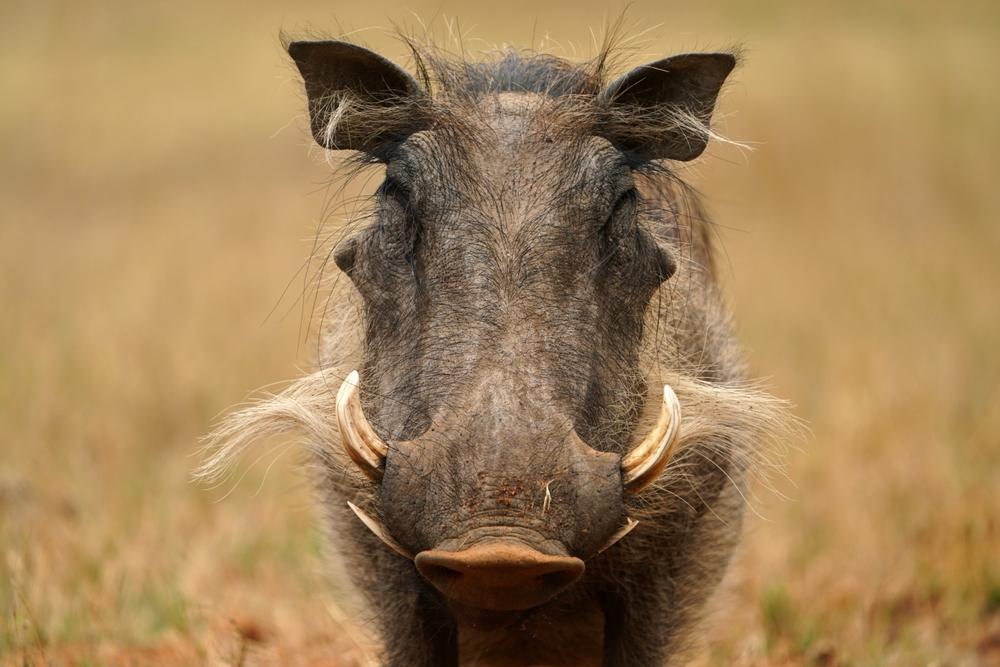
Namibia is best known for its plains game hunting. Commonly hunted species include kudu, gemsbok, springbok, eland, red hartebeest, plains zebra, and warthog. Certain regions of the country — particularly the Zambezi Region (formerly Caprivi) — also offer dangerous game hunting opportunities including elephant, buffalo, hippopotamus, and crocodile. Species availability can vary depending on the hunting area and property being visited.
The cost of a Namibia hunting safari depends on several factors, including the length of the safari, species being hunted, daily rates charged by the outfitter, trophy fees for animals taken, and taxidermy and shipping costs. Many plains game safaris range from 7 to 10 hunting days, with hunters pursuing multiple species during a single trip. Compared with many dangerous game-focused destinations in Africa, Namibia often allows hunters to pursue several plains game animals within a single safari budget.
Namibia's primary hunting season typically runs from February through November. Many professional hunters consider the cooler winter months from May through August to be particularly good for plains game hunting because vegetation becomes thinner, animals concentrate around water sources, and tracking conditions improve. However, productive hunts can occur throughout much of the season depending on the region and the species being pursued.
Shot distances vary depending on terrain. In mountainous regions such as the Khomas Highlands, many shot opportunities occur between 100 and 200 yards. In more open environments such as the Kalahari or the floodplains of the Zambezi Region, shots may occasionally be longer. Most professional hunters use tripod shooting sticks, which provide a stable shooting platform in uneven terrain. Hunters unfamiliar with shooting from sticks are strongly encouraged to practise before travelling.
Many common North American calibres work well for plains game hunting. Popular choices include .270 Winchester, .308 Winchester, and .30-06 Springfield. For dangerous game such as buffalo or elephant, larger calibres are typically required. The .375 H&H Magnum is widely considered the minimum legal calibre in many African countries. Hunters should always confirm calibre requirements with their outfitter before travelling.
Yes. Namibia allows visiting hunters to temporarily import hunting rifles with the proper documentation. This usually requires a valid passport, proof of firearm ownership, a completed temporary firearm import form, and an invitation letter from the outfitter. When paperwork is prepared before arrival, the process at the airport is typically straightforward. Many outfitters assist their clients with the necessary documentation prior to travel.
Most plains game safaris last seven to ten hunting days. This timeframe generally allows hunters enough time to pursue several species while still enjoying the full experience of the safari. Longer safaris may be required when hunting dangerous game or when targeting specific trophy animals such as mature kudu bulls or elephant.
Namibia is widely regarded as one of the safest and most stable countries in southern Africa. The country maintains a democratic political system, reliable infrastructure, and a long-standing reputation for welcoming international visitors. Most hunting safaris take place in remote rural areas on private land or conservancies, far from major urban centres. Hunters travelling with reputable outfitters typically find Namibia to be a safe and comfortable destination.
Hunting in Namibia often involves spot-and-stalk hunting across large landscapes. Hunters may spend time glassing distant hillsides, tracking animals through sandy soil, or carefully stalking animals using wind and terrain for cover. Unlike some North American hunts where animals may be encountered quickly, Namibia often rewards patience and careful planning before a shot opportunity develops. For many hunters, this style of hunting is part of what makes an African safari so memorable.
Namibia offers a slower, more deliberate hunting experience compared to countries with higher game densities. Hunts often involve long hours of glassing, tracking across wide terrain, and careful shot selection. Success is earned through patience rather than volume shooting, which appeals to hunters who value challenge and space.
Absolutely. Namibia offers a range of non-hunting activities, including wildlife safaris, cultural tours, and nature walks for non-hunting family members.
Yes, many hunters choose to combine big game and plains game hunts, making the most of Namibia's diverse wildlife.
Yes, you can bring trophies back to the USA, but you will need to follow the proper export and import procedures, which we assist with.
30 January 2026 27 January 2026
Latest Blogs About Namibia
Why American Sportsmen Enjoy Hunting in Namibia
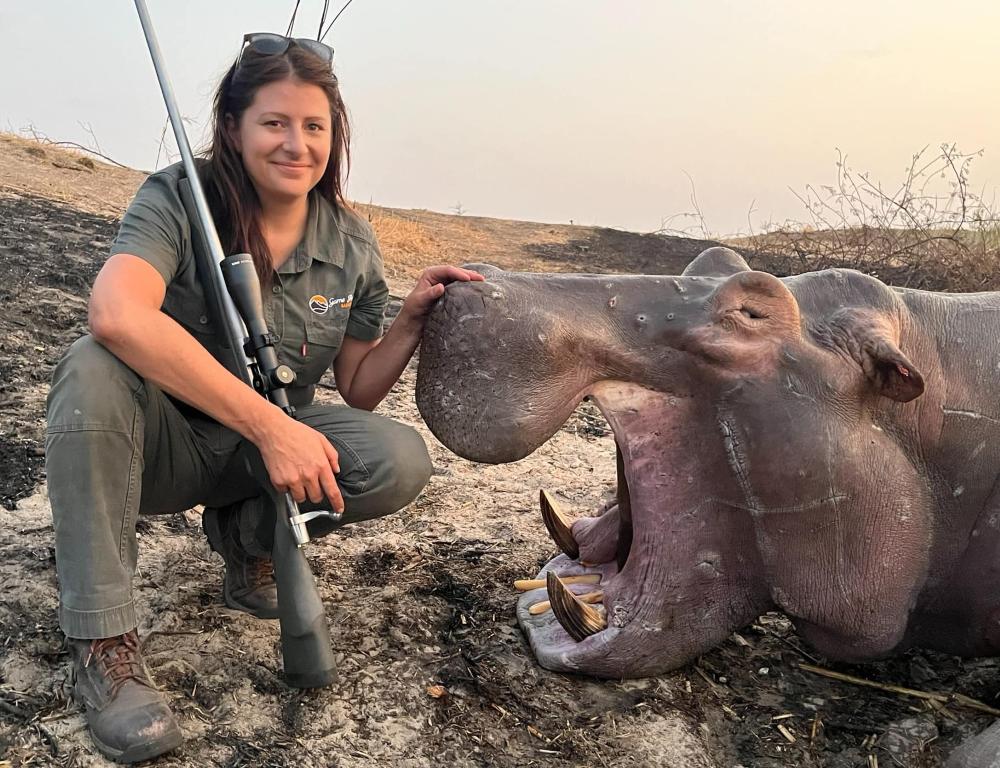
Women’s Hunting Trips in Namibia: Safe, Sought-After Safaris
Search from our range of Hunts across various popular destinations in Africa.

Book Your Hunt