
Published: March 2026
Author: Game Hunting Safaris Team
[DYNAMIC-BLOGTABLEOFCONTENT]
Why Baboon Hunting Exists in Africa
Baboon hunting in Africa is a topic that often surprises visiting hunters to the “dark continent.” Unlike most African safari animals, baboons are not pursued primarily as trophy animals. Instead, they are often encountered during plains game safaris where they are widely considered agricultural pests in many rural areas.
When American hunters begin researching African safaris, one question often appears very early.
Why would anyone hunt a baboon?
The answer lies in the complicated relationship between baboons and the rural communities that share the landscape with them. It’s a tough and complex give and take between the two.
Across large parts of Southern Africa, baboons are not simply another species living in the bush. In fact, in many farming regions and communities they are viewed as one of the most persistent and frustrating agricultural pests on the continent, and their dominant and aggressive natures can be quite frightening.
Large troops move through farmland raiding crops, damaging infrastructure, and occasionally preying on small livestock, such as lambs, piglets, chickens, and even calves.
Anyone who has spent time hunting across Southern Africa has likely witnessed this first-hand. A troop of baboons moving through farmland can cause utter chaos in a matter of mere minutes. A maize field that looked healthy early in the morning may be badly damaged by the afternoon, leaving a farmer’s crop in disarray.
Because baboons are highly intelligent and adaptable animals, once they discover an easy food source, they unfortunately rarely forget it and will return time and again for a “free meal.”
Farmers often describe baboons as one of the most difficult animals to deal with in terms of unwanted pests. Unlike many wildlife species that simply move on once disturbed, baboons quickly learn where food is available and how to access it.
For farmers trying to protect crops, livestock, and property, managing baboon populations becomes a constant challenge that cannot be ignored.
Responsible hunting safaris sometimes plays a role in helping control these populations. In many areas this management occurs on private farmland where baboon populations thrive due to abundant food sources and relatively few natural predators.
For visiting hunters, encountering baboons often becomes an unexpected but memorable part of a safari experience. Hunters interested in learning more about baboon hunts often discover that these animals are far more intelligent, cautious, and difficult to hunt than they first imagined.

Quick Baboon Hunting Facts
Species most hunted: Chacma baboon
Average weight: 30–40 kg (65–90 lbs)
Habitat: Rocky hillsides, mountains, farmland edges, river valleys
Hunting method: Spot-and-stalk or opportunistic
Difficulty level: High
Unlike most African plains game species, baboons are rarely the primary focus of a safari. Instead, they are usually hunted opportunistically while pursuing other animals such as kudu, impala, or wildebeest trophies.
However, experienced hunters quickly learn that successfully hunting a baboon can be far more difficult than it initially appears.
Their eyesight, intelligence, and constant awareness make them one of the most challenging animals in Africa to approach undetected.
The Chacma Baboon – One of Africa’s Largest Primates
The baboon species most commonly encountered during hunting safaris in Southern Africa is the Chacma baboon (Papio ursinus).
Chacma baboons occur widely across:
• South Africa
• Namibia
• Botswana
• Zimbabwe
• Mozambique
Adult males can weigh close to 40 kilograms, making them one of the largest baboon species worldwide.
Large males possess extremely powerful jaws and long canine teeth that can inflict serious injuries, and even death, if the animal feels threatened.
Despite their sometimes comical appearance, chacma baboons are powerful and highly intelligent animals that command respect. You will note that locals in communities approach these mammals with caution, as they are strong and powerful, can get aggressive extremely quickly.
They live in organized social groups known as troops, which can range from 20 to more than 50 individuals.
Within these troops there is a strict hierarchy, with dominant males controlling breeding opportunities and access to food resources.
This complex social structure, combined with their intelligence, makes baboons some of the most alert animals in the African bush.
The Different Baboon Species in Africa
While hunters in Southern Africa usually encounter the Chacma baboon, Africa is home to several baboon species scattered across the continent.
These include:
Chacma Baboon (Papio ursinus)
The most common species encountered during hunting safaris in Southern Africa.
Olive Baboon (Papio anubis)
Found across East and Central Africa, including Kenya, Tanzania, and Uganda.

Yellow Baboon (Papio cynocephalus)
Common throughout East Africa's savannah regions.
Guinea Baboon (Papio papio)
Primarily found in parts of West Africa.
Hamadryas Baboon (Papio hamadryas)
Native to Ethiopia and the Horn of Africa.
Although these species vary in appearance and geographic distribution, their behavior and social structures are very similar.
For hunters visiting Southern Africa, the chacma baboon is by far the species most commonly encountered during a hunting safari.
Why Farmers Consider Baboons Agricultural Pests
Baboons are opportunistic omnivores, meaning they will eat almost anything available.
In farming areas they frequently raid:
- Maize fields
- Fruit orchards
- Vegetable crops
- Grain storage areas
Because baboons move in large, coordinated troops, the damage and destruction they cause can be extensive.
Farmers often describe watching a troop move through farmland as similar to a swarm of locusts passing through, leaving chaos in their wake.
Entire rows of crops may be flattened or stripped in a very short time.
Once baboons discover a reliable food source they quickly return repeatedly, often day after day to take advantage of a free food source,
Their intelligence allows them to learn where crops are grown and how to bypass deterrents such as fences, dogs, or human patrols.
For farmers trying to protect crops and infrastructure, baboons can become an ongoing challenge they need to face.
Baboons and Livestock Predation
Another reality that surprises many hunters is that baboons sometimes prey on small livestock.
Large males have been known to kill:
• newborn lambs
• young goats
• poultry
They may also kill young antelope calves when the opportunity presents itself.
While baboons are not traditional predators like lions or leopards, they are extremely opportunistic and will take each chance they get.
If an easy meal presents itself, they will take advantage of it.
Baboons and Vineyard Damage
In South Africa's wine-producing regions, baboons have become a significant challenge for vineyard owners.
Troops often descend from nearby mountain ranges and move into vineyards where grapes are grown.
A troop of 30 or 40 baboons can strip grapes from vines very quickly.
Entire sections of vineyards may be damaged within a single morning.
Farmers often attempt deterrents such as fencing, patrols, or guard dogs, but baboons quickly learn how to bypass these systems.
Their intelligence allows them to identify weak points in fences or barriers, which they may continue to use to gain access to the crops.
Are Baboons Dangerous to Humans?
Baboons are not considered dangerous game, but they are certainly capable of defending themselves if threatened or cornered.
Large adult males possess long canine teeth and extremely powerful jaws. These teeth are designed for fighting other males and can cause serious injuries.
In most wilderness areas baboons prefer to avoid humans altogether. Their sharp eyesight and constant vigilance usually allow them to detect people long before a person ever notices them.
However, in areas where baboons have become accustomed to humans — such as some parts of Cape Town or tourist areas — they may enter houses, raid food, or confront people.
They are always watching.
Hunters. Farmers. Vehicles.
Even dogs.
This constant awareness is one of the reasons baboons are so difficult to approach during a hunt.
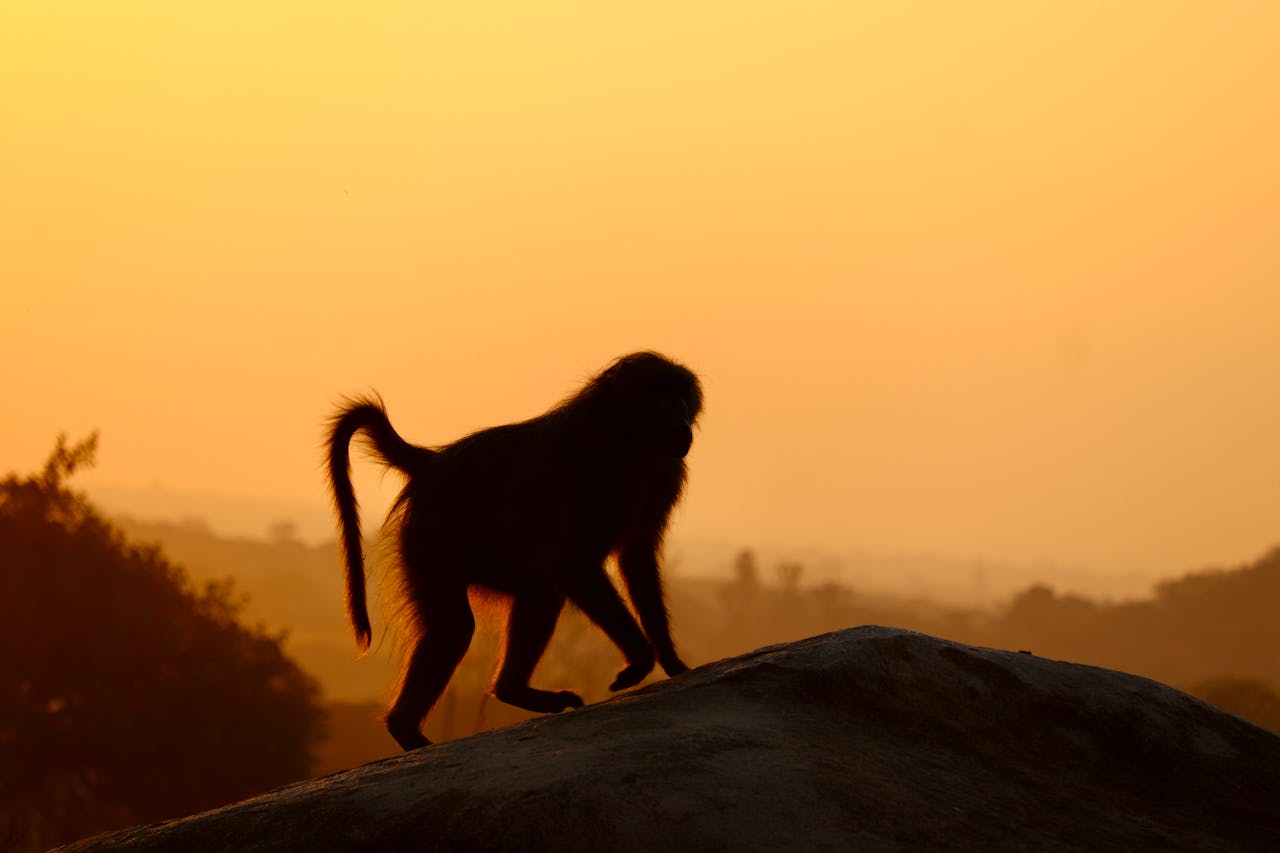
A baboon troop will often place one or two animals on elevated rocks or trees to act as sentries while the rest of the troop feeds. These lookouts constantly scan the landscape.
If danger approaches, the sentry immediately sounds a loud barking alarm call and the entire troop disappears into rocks or thick bush within seconds.
What Animals Hunt Baboons in Africa
Despite their intelligence and social organization, baboons do have natural predators.
The most important predator of baboons is the leopard.
Leopards are incredibly stealthy hunters and frequently prey on baboons that stray too far from the protection of their troop.
In some cases leopards will ambush baboons from trees or rocky ledges, using terrain and concealment to get close before launching a sudden, unexpected attack.
Other predators that occasionally hunt baboons include:
• lions
• hyenas
• crocodiles near river systems
However, it must be noted that baboons are far from defenseless.
Troops will often work together to mob predators, surrounding them while making loud barking calls.
Anyone who has spent time hunting in Africa has likely heard the unmistakable sound of baboons barking warnings across valleys and hillsides.
Those alarm calls often signal that a predator — most commonly a leopard — is moving through the area.
How Intelligent Are Baboons?
Baboons are widely considered among the most intelligent animals in Africa and are frequently studied by wildlife researchers for their complex social behavior.
Their DNA is surprisingly close to that of humans, and their ability to solve problems can be quite remarkable.
Stories about baboon intelligence are common throughout Africa.
In some areas specially designed garbage bins were introduced to prevent baboons from opening them.
Within days, baboons had already figured out how the locking mechanisms worked.
Farmers often say that if baboons discover a weak point in a fence or barrier, they will remember it for years.
Professional hunters sometimes jokingly describe baboons as behaving like a gang of clever petty criminals — constantly watching, learning, and adapting their behavior.
This intelligence is one of the main reasons baboon hunting can be surprisingly challenging.

Why Baboon Hunting Is Surprisingly Challenging
Despite being considered pests in some areas, baboons are far from easy animals to hunt.
They possess excellent eyesight and constantly monitor their surroundings.
Troops often position lookout animals on elevated rocks or trees while the rest of the group feeds.
Experienced professional hunters often say a baboon can detect movement from hundreds of yards away.
Many hunters have experienced the same frustrating situation.
They carefully stalk into position believing they are completely unseen.
Suddenly the entire hillside erupts with barking baboons disappearing over rocks and ridges.
The troop vanishes almost instantly.
The hunters stand there wondering how they were spotted so quickly.
Sometimes you get one…but most times the baboons win.
Why American Hunters Rarely Turn Down a Big Baboon
There is a moment that often happens during an African safari: A hunter may spend days carefully evaluating kudu bulls, looking for the right animal to pursue.
Then suddenly a large adult baboon appears sitting high on a rock watching the hunters.
The professional hunter quietly whispers:
“There’s a big one.”
Almost every American hunter instinctively reaches for the rifle.
Baboons fall into a slightly different category on safari, they are not measured the same way as trophy antelope.
Instead, they represent a challenge — an opportunity to outsmart one of the most alert animals in the African bush.
Sometimes the hunter wins.
But very often the baboon disappears over the rocks before the hunter even gets a chance to take aim.
Why Hunters Often Add Baboon to Their Safari
For many hunters visiting Africa, baboons become an unexpected but entertaining part of the safari experience.
While pursuing plains game such as kudu, impala, or wildebeest, hunters frequently encounter baboon troops moving across rocky hillsides or farmland edges.
Because baboons are intelligent, cautious, and extremely alert, many hunters enjoy the added challenge of trying to outsmart them. Truth be told, it is a challenge that many hunters often lose, but enjoy relaying the tale of their baboon experience.
Spend enough time hunting in Africa and you quickly learn one important lesson about baboons.
They are always watching.
And more often than not…they are already one step ahead of you.

What Happens to the Meat After a Baboon Hunt?
One question many visiting hunters ask is what happens to the meat after a baboon is harvested.
Unlike most plains game animals in Africa, baboons are not widely eaten.
In many rural communities the meat is simply not considered desirable.
On some farms the carcass may be used as bait for predators such as leopard or hyena.
In other situations, it may simply be disposed of.
Occasionally someone will joke about the reason locals avoid eating baboon meat.
One farmer once laughed and said eating baboon would feel a little like eating one of his cousins — and most people nearby seemed to agree.
There is some truth behind the humor. Because baboons are primates and share certain similarities with humans, many people feel uncomfortable with the idea of eating them.
For most hunters, the purpose of a baboon hunt is therefore not meat or trophy value, but the challenge of outsmarting one of the most intelligent animals in Africa.
Frequently Asked Questions About Baboon Hunting in Africa
Are baboons dangerous to humans?
Baboons are not considered dangerous game, but they can defend themselves if threatened. Large males possess powerful jaws and long canine teeth capable of causing injury. In wilderness areas they usually avoid people. People do, however, remain cautious around baboons as they can be unpredictable and aggressive if provoked.
Do baboons attack humans?
Wild baboons rarely attack people in remote areas. Most aggressive encounters occur where baboons have become accustomed to human food, such as towns or tourist locations.
Why are baboons hunted in Africa?
Baboons are sometimes hunted because they cause significant agricultural damage. Troops can raid crops, damage vineyards, and occasionally prey on small livestock.
Are baboons difficult to hunt?
Yes. Their excellent eyesight, intelligence, and constant vigilance make them one of the most challenging animals in Africa to approach undetected.
Do people eat baboon meat?
Baboon meat is rarely eaten in most parts of Southern Africa. In some cases the carcass may be used as bait for predators such as leopard.
What species of baboon are hunted in Africa?
The species most commonly encountered during hunting safaris in Southern Africa is the chacma baboon (Papio ursinus).
Author
Game Hunting Safaris Team
Pierre and Tamlyn have hunted across Africa for many years and have spent extensive time in the African bush pursuing plains game throughout Southern Africa.
Anyone who spends enough time hunting the African bush quickly learns that baboons are among the smartest animals you will encounter. Their intelligence, curiosity, and ability to outsmart hunters make them one of the most memorable animals on safari.